Charts in your language
Lahiri sidereal signs, whole-sign houses, Rahu and Ketu. Your Moon nakshatra and pada on the Birth Chart page.
Jyotish reads the sky from the fixed stars. Astro Mate draws your chart with Lahiri ayanamsa, whole-sign houses, Rahu and Ketu, then scores matches with the Ashtakoota table used in kundli matching.
Free natal chart · 1,500 credits on sign-up · no subscription

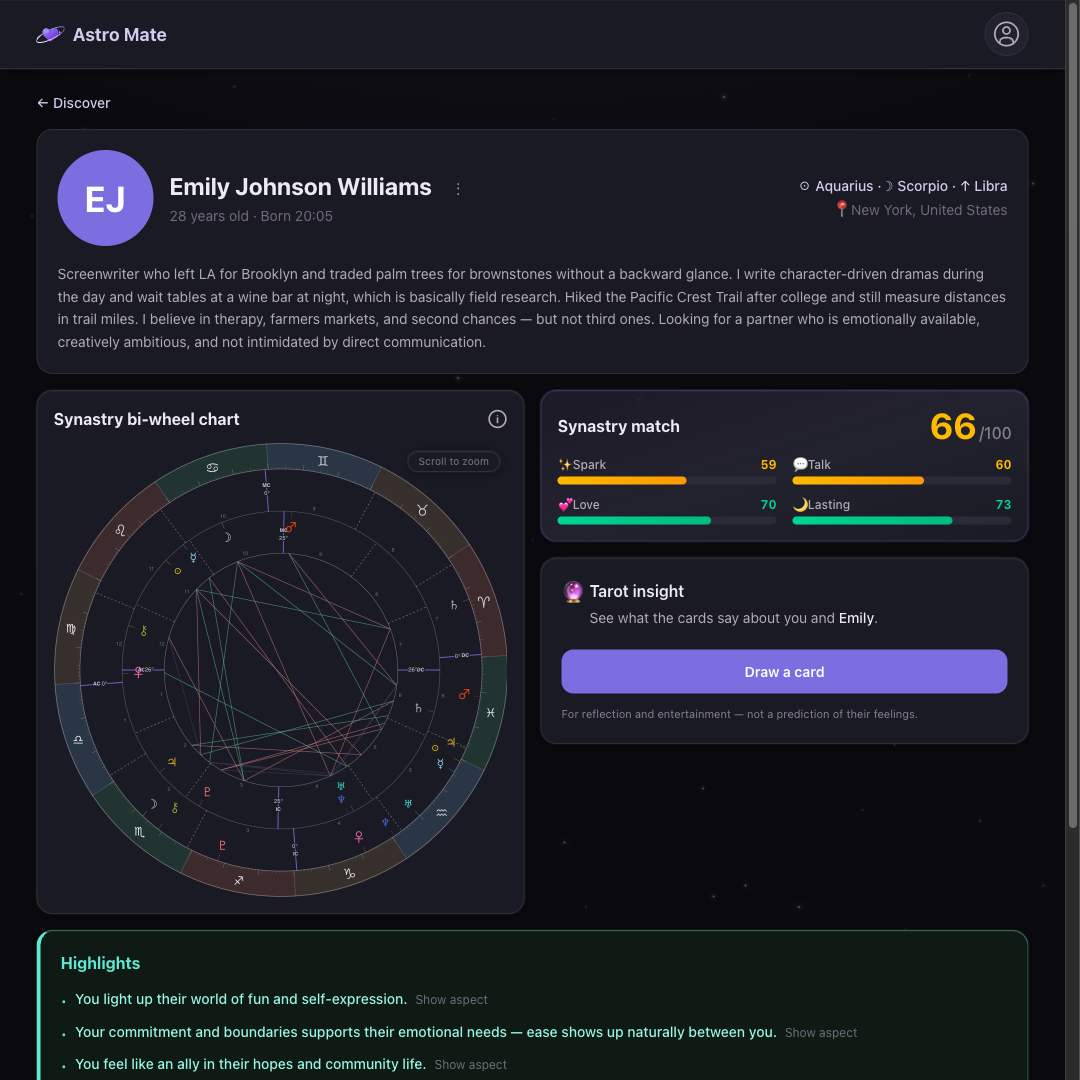
Ashtakoota starts from both Moon nakshatras. Eight questions, 36 points, one total you read together with the person in front of you.
Lahiri sidereal signs, whole-sign houses, Rahu and Ketu. Your Moon nakshatra and pada on the Birth Chart page.
Varna through Nadi, each with its cap and plain language detail. Alex and Maya score 26, a very good match.
Your frame follows you. A Vedic viewer sees Vedic signs and scores against any profile, never mixed frames.
Add your birth date, time, and place. Your free natal chart takes about two minutes and powers every match.
Open profile settings, choose Vedic (Sidereal), and save. The wheel redraws with the Lahiri line and your Moon nakshatra.
After a match, open Guna Milan and pick one row that surprises you. Bring it into conversation, not into verdicts.
Western practice pins 0 Aries to the spring equinox. Vedic practice (jyotisha) pins it near the fixed stars. The two agreed about two millennia ago and now differ by about 24 degrees through precession. Astro Mate uses Lahiri ayanamsa, the offset behind the Indian national calendar, because most Vedic charts you have seen were drawn with it.
Varna (1) checks Moon sign order. Vashya (2) checks mutual influence between sign types. Tara (3) counts auspicious directions between birth stars. Yoni (4) maps animal symbols for instinctive affinity. Graha Maitri (5) compares the friendship of the Moon sign lords. Gana (6) reads temperament as Deva, Manushya, or Rakshasa. Bhakoot (7) watches Moon sign distance for dosha, with cancellation when lords are friendly. Nadi (8) compares pulse types, where same nadi scores zero.
Save Vedic in your profile and the Birth Chart page shows the Lahiri line plus your Moon nakshatra and pada. After a match, compatibility becomes Guna Milan with an info drawer behind each koota. Traditional viewers keep the four bars: attraction, communication, love, and long-term potential.
Profiles come first on Astro Mate: photos, bio, big three, a real human across the thread. A high total is not permission to skip questions. A low row is not a stop sign. Use one surprising koota as an opening question and let the conversation lead.
Guna Milan is the Ashtakoota matching score from classical kundli matching: eight kootas worth 36 gunas, computed from both Moon nakshatras, padas, and Moon signs. Below 18 reads as difficult, 18 to 24 acceptable, 25 to 32 very good, 33 and above excellent.
Three mechanics move together: sidereal signs with Lahiri ayanamsa, whole-sign houses from the lagna, and a classical cast of seven planets plus Rahu and Ketu. The Birth Chart page adds the Lahiri note and your Moon nakshatra with pada. Traditional charts stay on tropical Placidus.
No. The viewer frame rules. A Vedic viewer sees Vedic signs, houses, nodes, and Guna Milan against any profile, even one whose owner uses Traditional. Both charts recompute in your frame so a tropical Leo is never mixed with a sidereal Karka.
Birth date, exact time, and place give the most complete result, because the Moon nakshatra moves fast. With an unknown birth time the Moon placement loses precision, so recover the time when you can.
No. Scores are prompts for conversation, not verdicts. A zero on Yoni names instinctive friction worth noticing. A Nadi dosha (same nadi, zero of 8) is a classical flag, not a command. Consent, communication, and time outrank any table.
Vedic mode covers the rashi chart, Moon nakshatra, Vimshottari dasha on your birth chart, sidereal daily gochara in Astro Digest, and Guna Milan. Planet-wise nakshatras and vargas such as navamsa are not included yet.
Build your free chart, then explore the part of Astro Mate that feels most like you.